Acupuncture Explained
Acupuncture in Islington N1 is provided by Gulshan Noorani, an experienced practitioner with 14 years of clinical practice. Gulshan also has experience in Chinese herbal medicine and nutritional therapy, bringing a broad perspective to individual patient care.
Treatment incorporates principles from both Traditional Chinese Medicine and Western approaches to acupuncture, with the choice of techniques tailored to your individual presentation and treatment goals.
Your appointment begins with an assessment of your symptoms, health and relevant medical history before an appropriate treatment approach is discussed. Acupuncture may be used as part of a wider approach to managing pain, muscular tension and other health concerns, depending on your individual circumstances.
Our acupuncture practice follows the British Acupuncture Council’s professional guidelines, with patient safety and appropriate clinical practice at the centre of treatment.
Approaches used in clinic
Traditional Chinese medicine acupuncture. Diagnosis and point selection based on classical TCM theory.
Korean acupuncture. A distinct system with its own diagnostic framework and point protocols.
Balance method. Points are selected on one part of the body to influence another, often allowing treatment away from the painful area.
Motor point acupuncture. Needling directed at the motor points of specific muscles.
Scalp acupuncture. Points on the scalp used within neurological and pain-focused protocols.
One-needle acupuncture. A minimal approach using a single carefully chosen point.
Neuroacupuncture. A contemporary method combining scalp acupuncture with active movement during treatment.
Dolphin MPS. A handheld device applying microcurrent to acupuncture points, used as a needle-free alternative.
Cupping. Suction cups applied to the skin to affect local circulation and soft tissue tension.
What acupuncture is used for here
- Chronic pain, including persistent lower back pain
- Musculoskeletal pain such as neck and shoulder complaints
- Migraine prevention
- Tension-type headache
- Nausea and vomiting following surgery or chemotherapy
What to expect
Your first acupuncture appointment lasts 60 minutes and begins with a detailed consultation. Your practitioner will ask about your current symptoms, medical history, sleep, digestion, general health and other factors that may be relevant to your treatment.
Where Traditional Chinese Medicine principles are being used, your assessment may also include examination of the tongue and taking the pulse at both wrists. This information helps your practitioner develop an individualised treatment approach.
What does acupuncture feel like?
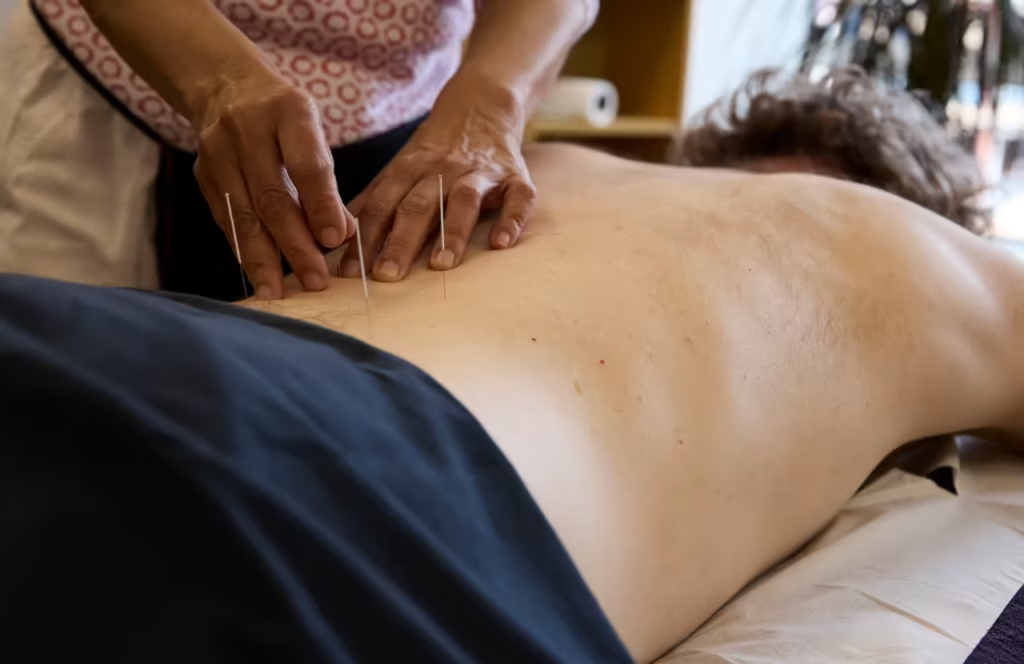
Acupuncture needles are sterile, single-use and disposable. They are extremely fine compared with needles used for injections. Most people experience little discomfort when a needle is inserted, although you may notice a brief tingling sensation or a dull, heavy or aching feeling.
Once the needles have been positioned, they are typically left in place for around 20 minutes while you rest. Your practitioner will monitor you during treatment and make sure you are comfortable.
How might you feel after acupuncture?
People respond differently to acupuncture. Some feel relaxed or tired after treatment, while others feel more energised. Your practitioner can advise you on what to expect based on your individual treatment.
Follow-up acupuncture appointments also last 60 minutes, allowing time to review how you have responded and adapt your treatment where appropriate.
Visiting us
The clinic sits on Prebend Street in N1, close to Essex Road overground and Angel and Highbury and Islington Underground. Full travel information is on the clinic page.
Your Practitioner
Qualifications, registration numbers and clinical interests are set out on each team member’s profile.
Fees
Cover for acupuncture varies considerably between policies. Check with your provider before your first appointment to see whether your plan includes it. Charges for our other treatments are shown on the fees page.
| Appointment | Duration | Fee |
|---|---|---|
| Initial consultation and treatment | 1 hour | £99 |
| Follow-up | 1 hour | £85 |
| 5-session package | £403.75 (5% saving) | |
| 10-session package | £765 (10% saving) |
Visiting Us
The clinic sits on Prebend Street in N1, close to Essex Road overground and Angel and Highbury and Islington Underground. Full travel information is on the clinic page.
Questions Patients Ask
Does acupuncture hurt?
Acupuncture needles are extremely fine. Sensation is usually described as a dull heaviness or a brief tingle rather than pain.
How many sessions will I need?
Your practitioner will discuss this after the initial consultation. A course of several sessions is typical, with progress reviewed as you go.
Are the needles clean?
Yes. All needles are sterile, single-use and disposed of immediately after treatment.
Should I eat before an appointment?
Have something light beforehand rather than arriving on an empty stomach or straight after a large meal.
Can I have acupuncture alongside other treatments?
Yes, many patients combine it with chiropractic, physiotherapy or massage at the clinic. Do tell your practitioner about any other treatment and any medication you take.