Verruca Needling Explained
Verruca needling is a procedure for verrucae that have proved resistant to standard topical treatment. It is carried out under local anaesthetic at our Prebend Street clinic by an HCPC-registered podiatrist.
When needling is considered
Most verrucae are treated first with topical preparations applied over a course of appointments. Some clear quickly. Others persist for months or years, sometimes spreading into clusters or becoming painful to walk on.
Needling is generally considered when topical treatment has been given a fair trial without success, when a verruca is large or long-standing, or when there are several lesions that would be impractical to treat individually. Our podiatry service page explains the wider range of foot care available here.
How the procedure works
The principle is different from treatments that try to destroy the lesion directly. Needling deliberately punctures the verruca repeatedly so that viral particles are introduced to the deeper tissue below, where the immune system can recognise them. The aim is to provoke an immune response against the virus causing the verruca.
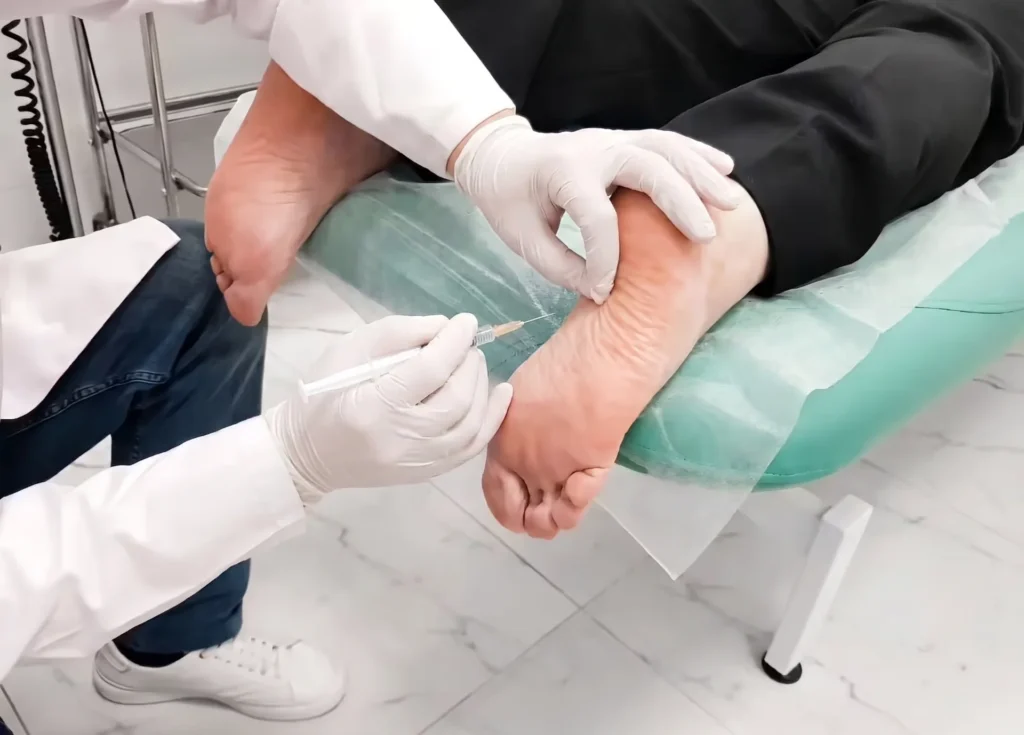
The area is numbed with local anaesthetic first, so the procedure itself should not be painful. Your podiatrist then works over the lesion with a sterile needle, and a dressing is applied afterwards. The appointment is usually straightforward and does not take long.
A practical advantage of the technique is that a single treatment is often enough. Where there are several verrucae, treating one lesion can be sufficient, because the immune response is not confined to the site that was treated.
Afterwards
Your podiatrist will give you aftercare instructions covering dressings, keeping the area dry and what footwear to wear. Expect the site to feel tender once the anaesthetic wears off, so it is worth planning a quiet day or two rather than a long walk or a training session.
A review appointment is arranged to check healing and to monitor whether the lesion is resolving. Results are not immediate, because the immune response takes time to develop, and your podiatrist will explain what to expect and over what sort of timescale.
Your Podiatrist
Qualifications, registration numbers and clinical interests are set out on each team member’s profile.
Fees
Every treatment we offer is listed together on our fees page.
| Appointment | Duration | Fee |
|---|---|---|
| Verruca Needling | £250 | |
| Topical Verruca Treatment Appointments | £65 | |
| Follow-ups | 15 minutes | £40 |
Getting to the Clinic
The procedure takes place at 15 Prebend Street, London N1 8PF. Because your foot will be dressed and tender afterwards, think about how you will travel home before you book. Transport options are listed on the clinic page.
Questions About Needling
Is verruca needling painful?
The procedure is carried out under local anaesthetic, so you should not feel the needling itself. The injection to numb the area stings briefly, and the site is usually sore for a day or two afterwards.
How many treatments will I need?
Often only one. Your podiatrist will review the site and advise whether anything further is needed.
Can I walk afterwards?
Yes, but keep it short on the day of the procedure and avoid running or long periods on your feet until the site has settled.
Is it suitable for children?
Verrucae are very common in children and often clear without intervention, so a gentler approach is usually tried first. Bring your child in for an assessment and the podiatrist will advise on what is appropriate for their age and the lesion involved.
Will it leave a scar?
Scarring is uncommon with needling, which is one reason it is favoured over some more destructive treatments.